- Home
- Korean Driving Licence
- Skills Test
Korean Driving Skills Test
The Korean driving skills test evaluates your ability to control a vehicle safely on a closed driving course. For Class 1 Regular and Class 2 Regular, you must score at least 80 points and complete every required section without making an instant-failure error. SDA provides structured training on the actual academy test course with English assistance for foreign applicants.
| Test information | Class 1 and Class 2 Regular |
|---|---|
| Passing score | 80 out of 100 |
| Course distance | At least 300 metres |
| Test location | Closed driving course |
| Official test fee | 25,000 KRW |
| Foreign-language support | English and Chinese audio/screen |
| Retest waiting period | Three days after failure |
| Next step after passing | Learner's permit |
Swipe the table to see all columns.
What Is the Korean Driving Skills Test?
Also called the driving course test, closed-course driving test, driving function test, or 장내기능시험 in Korean — it takes place on a controlled course rather than public roads. The test checks whether you can prepare the vehicle correctly, operate essential controls, start and stop safely, maintain the correct lane, respond to traffic signals, stop and restart on a slope, turn correctly, complete a right-angle parking task, accelerate when required, and follow the automated test instructions.
The course uses sensors and an automated scoring system. Points can be deducted even when the examiner does not personally intervene.
When Do You Take the Skills Test?
For a new Class 1 or Class 2 Regular licence: complete the required theory and safety education → complete the physical examination → pass the written test → complete driving-skills training → pass the skills test → receive a learner's permit → complete road-driving training → pass the road-driving test → receive your Korean licence. You must pass the written test before completing the official skills-test stage.
Korean Skills Test Course
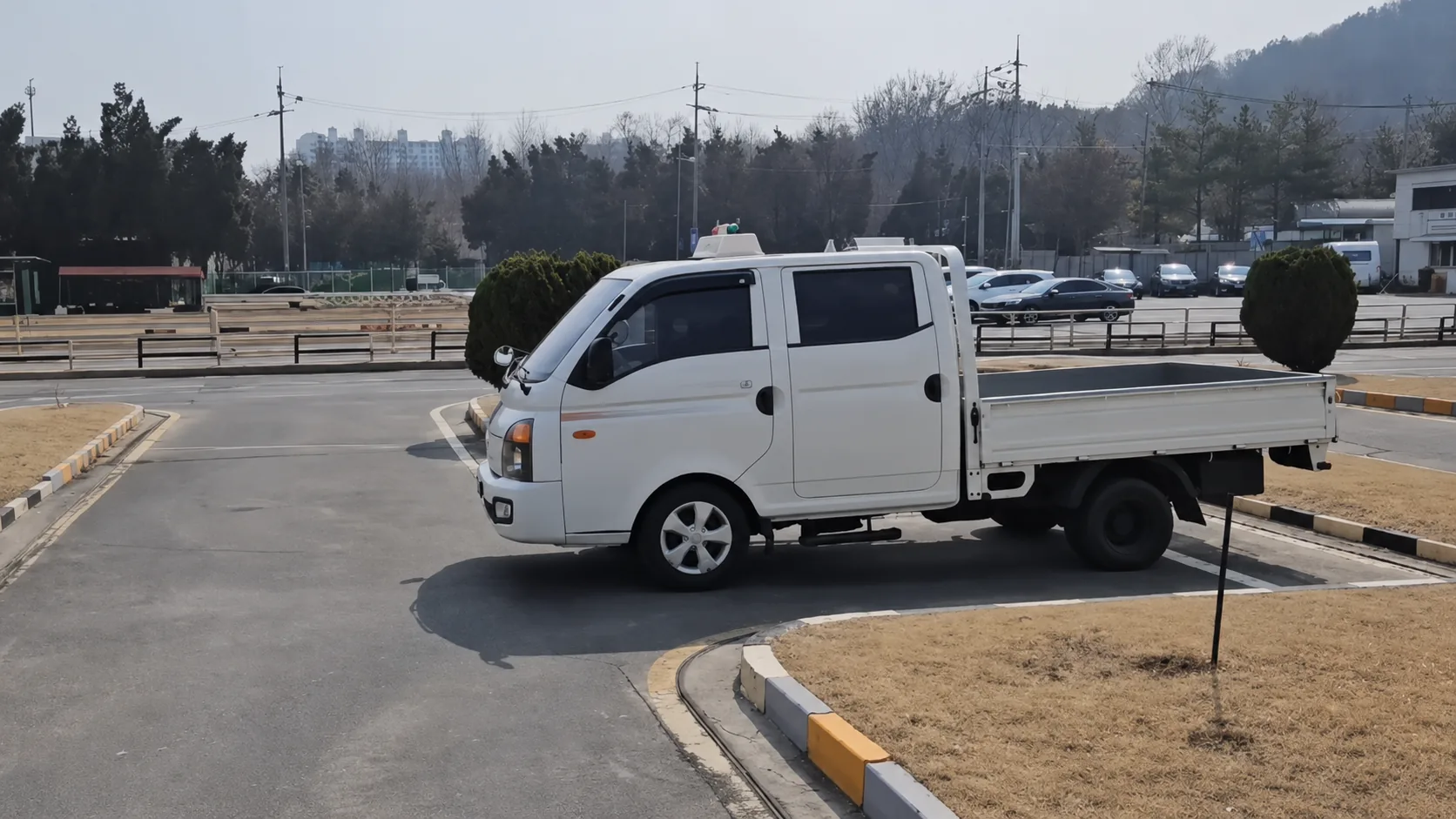
The Class 1 and Class 2 Regular test course covers a driving distance of at least 300 metres. The order can depend on the course layout and test system — SDA training helps you learn both the physical route and the sequence of actions required by the automated scoring system.
- Vehicle-control operation
- Lane maintenance
- Sudden-stop response
- Slope or hill-start section
- Left and right turns
- Right-angle parking
- Signal-controlled intersection
- Forward acceleration section
- Start and finish procedures
Course Sections in Detail
- 1
Vehicle-control operation & starting procedure
The test may instruct you to operate headlights, high/low beams, turn signals, wipers, the parking brake or gear selector. Before moving: adjust the seat, fasten the seat belt, check mirrors, confirm gear position, and start the engine. Not wearing the seat belt from start to finish causes immediate failure. You must leave the starting line within 30 seconds of the instruction. Common mistakes: operating the wrong control, responding too slowly, or starting before the instruction is complete.
- 2
Lane maintenance & turns
Stay within the designated lane throughout, with stable steering, correct position, appropriate speed and proper indicator use. If any wheel touches a curb, the result may be immediate failure. Common problems: turning too early or late, looking only at the front of the vehicle, and letting the rear wheel drift toward the curb.
- 3
Sudden-stop section
The system may instruct an emergency stop — recognize the signal, brake promptly and safely, stop completely, follow the required post-stop procedure, and restart only when instructed. This measures whether you can react quickly while keeping control.
- 4
Slope / hill-start section
Stop within the designated area, hold the vehicle safely, and restart without excessive rollback, within the allowed time. Instant failure: passing through without stopping, taking more than 30 seconds to pass after stopping, or rolling back one metre or more. Class 1 (manual) needs careful clutch/brake/accelerator coordination; Class 2 (automatic) should practise stable braking and smooth acceleration without panic.
- 5
Right-angle parking (T-parking)
Enter the designated parking area and complete the required confirmation procedure without touching the curb or leaving the course. Checked: entry position, steering timing, rear-wheel path, alignment, required confirmation-line contact, and safe exit. Failing to reach the confirmation line can be treated as incomplete and result in failure. Common issues: entering from the wrong position, turning too early or late, and touching the curb.
- 6
Signal-controlled intersection
Follow the displayed signal and stop line: check the signal early, select the correct direction, use the indicator, stop before the line when required, and proceed only on the correct signal. Instant failure: violating the traffic signal, or the front bumper crossing the stop line when a stop is required. Don't just follow the vehicle ahead — check the signal yourself.
- 7
Acceleration section
Enter the acceleration area at the correct position, accelerate smoothly, perform the required gear operation (Class 1), then reduce speed safely while maintaining control and lane position. For manual vehicles, failing the required gear change can cause the section to be treated as incomplete.
How Is the Test Scored — and What Fails It Instantly?
Class 1 and Class 2 Regular applicants begin with a maximum score and lose points for errors involving vehicle-control operation, starting procedure, indicators, lane position, slope performance, parking procedure, traffic signals, acceleration, course completion and required timing. You pass with a final score of at least 80.
Instant-failure conditions (Class 1 & Class 2 Regular)
- Seat belt: not worn from the beginning of the evaluation until the end
- Accident or curb contact: causing a safety accident, or any wheel touching the curb
- Failure to follow instructions: ignoring the examiner's instructions or control
- Unable to start: not leaving the starting line within 30 seconds without valid reason
- Skipping a required section: e.g. passing the slope without stopping, entering parking without reaching the confirmation line, or missing a required manual gear change
- Slope failure: over 30 seconds to complete after stopping, or rolling back one metre or more
- Intersection violation: running the signal, or the front bumper crossing the stop line when a stop is required
Important: the automated system can end the test immediately after an instant-failure event, regardless of your score up to that point.
The exact deduction table is set by the Korea Road Traffic Authority and can change — check the current official scoring criteria rather than relying on an outdated fixed chart.
How the Two Tests Compare
| Item | Class 1 Regular | Class 2 Regular |
|---|---|---|
| Typical transmission | Manual | Automatic |
| Passing score | 80 | 80 |
| Hill-start, T-parking, signal & acceleration sections | Required | Required |
| Clutch control | Required | Not required |
| Manual gear change | Required where instructed | Not required |
Swipe the table to see all columns.
Class 1 applicants usually need more practice with
- Clutch control & stalling prevention
- Hill starts & gear changes
- Coordinating both feet, low-speed control
Class 2 applicants can focus more on
- Steering timing & braking
- Course position & parking reference points
- Following automated instructions
English Support During the Test
Official Class 1 and Class 2 Regular skills tests provide English and Chinese audio and screen support. However, language support does not replace practical training — you still need to understand when the instruction begins, how quickly you must respond, which control to operate, when to stop and move, and how to recognize an immediate-failure warning.
Why Practise on the Actual SDA Course?
Understanding the rules is not enough — you need to know how the vehicle moves through each section. Training on the actual SDA course helps you learn the layout, the vehicle's turning radius, wheel position, steering timing, the slope stopping area, T-parking reference points, the signal intersection, the acceleration zone, and the complete start-to-finish routine.
Practising in the same course environment can reduce uncertainty on test day — it does not guarantee a pass. Your result depends on your performance during the official test.
What SDA Skills-Test Training Covers
Training covers
- Driver's-seat setup, seat belt & starting procedure
- Basic vehicle controls & steering technique
- Low-speed control, left/right turns, emergency stop
- Slope stop/start, T-parking, signal intersection, acceleration
- Complete mock-course practice
- Point-deduction review & immediate-failure prevention
Suitable for
- Complete beginners
- Foreign applicants who need English explanations
- Class 1 manual & Class 2 automatic applicants
- Applicants who failed a previous skills test
- Applicants who passed the written test but haven't practised the course
What to Bring on the Test Day
- Valid ARC or Residence Card
- Completed application form
- Test reservation or academy schedule information
- Suitable closed-toe shoes
- Glasses or contact lenses if required for driving
- Any additional document requested for your application
A passport is not required for SDA registration. Avoid footwear that makes pedal control difficult, including unstable high heels or loose slippers.
Official Test Fee
| Licence category | Official test fee |
|---|---|
| Class 1 Regular | 25,000 KRW |
| Class 2 Regular | 25,000 KRW |
| Class 1 Large | 25,000 KRW |
| Class 1 Special | 25,000 KRW |
| Class 2 Small Motorcycle | 14,000 KRW |
| Motorized Bicycle | 10,000 KRW |
Swipe the table to see all columns.
The same official fee applies to a retest at an examination centre. SDA education, academy testing, insurance and other programme charges are shown separately in the complete cost table.
If You Fail — and What Happens After You Pass
If you fail
You don't need to repeat the written test immediately. You can normally retake the skills test after three days have passed from the failure date (e.g. failed Monday → earliest retest Thursday) — the same rule applies at a professional driving academy. Before retaking: identify where points were lost, confirm whether it was a point-score or instant failure, practise that section again, complete a full mock course, and check your next eligible date.
Validity: you must pass the skills test within one year of passing the written test, or you may need to reapply from the written-test stage. Traffic-safety education generally does not need repeating solely for this.
If you pass
You proceed to the learner's-permit stage. The learner's permit is required before road-driving, is generally valid for one year, is not a full licence, and does not permit unsupervised driving. Next: receive the permit → complete road-driving training → pass the road test → receive your Korean driving licence.
Motorcycle Skills Tests Are Different
The Class 2 Small Motorcycle and Motorized Bicycle tests use a different course and passing standard — both require 90 points, on an angled/curved/narrow course with continuous lane changes (motorcycle course requirements vary by vehicle type for mopeds). Applicants can fail for not starting in time, skipping a task, leaving the course, causing a safety incident, or not wearing required protective equipment.
Frequently Asked Questions
What is the Korean driving skills test?
It is a closed-course examination that evaluates basic vehicle control before the road-driving stage.
What score do I need to pass?
Class 1 Regular and Class 2 Regular applicants need at least 80 out of 100.
Is the test available with English instructions?
Yes. English audio and screen support is officially available for the Class 1 and Class 2 Regular skills test.
How long is the course?
The Class 1 and Class 2 Regular course has a driving distance of at least 300 metres.
Is T-parking included?
Yes. Right-angle parking, commonly called T-parking, is one of the required sections.
Is a hill start included?
Yes. Applicants must stop and restart correctly on the slope section.
What happens if I touch the curb?
If any wheel touches the curb, it can result in immediate failure.
What happens if I cross the stop line?
Crossing the stop line at the signal-controlled intersection when a stop is required can cause immediate failure.
Can I fail even if my score is above 80?
Yes. An instant-failure error ends the test regardless of your previous score.
Do I need to pass the written test first?
Yes. The written-test stage must be completed before progressing through the official skills-test process.
How much does the skills test cost?
The official examination-centre fee for Class 1 and Class 2 Regular is 25,000 KRW. SDA programme and training charges are separate.
Can I take the test again if I fail?
Yes. You can normally retake it after three days have passed from the failure date.
Do I have to repeat the written test after failing?
Not immediately. Your written-test result remains subject to its official validity period.
What comes after the skills test?
Class 1 and Class 2 Regular applicants proceed to the learner's permit and road-driving stage.
Is the Class 1 test harder than Class 2?
Both require 80 points, but Class 1 usually requires additional manual transmission, clutch and gear-control skills.
Can SDA guarantee that I will pass?
No. SDA provides structured training and course practice, but no academy can legitimately guarantee an official test result.
Can I take only the skills training course?
Availability depends on your licence status and the programme currently offered. Send SDA your written-test status and preferred date.
Prepare on the Actual SDA Test Course
Learn the full sequence before your test: vehicle controls, starting procedure, hill start, emergency stop, turns and lane control, T-parking, signal intersection, acceleration, and instant-failure prevention.
- Training on the actual academy test course
- English assistance for foreign applicants
- Five minutes from Gwanak Station Exit 1, Line 1
Book Skills Test Training
Tell us whether you need Class 1 Manual or Class 2 Automatic, and whether you've passed the written test.
599 Anyang-ro, Manan-gu
Anyang-si, Gyeonggi-do. 경기도 안양시 만안구 안양로 599 — Gwanak Station, Exit 1, Line 1, approximately five minutes on foot.
