Genuinely English throughout
The main reason anyone makes this journey. Theory, circuit and road instruction, for over ten years.
It is a long train ride, and we will not pretend otherwise. Scheduled properly it is three trips, not thirty — and the whole course is in English.
Pyeongtaek, Jije, Seojeong-ri and Songtan all sit on Line 1, which runs directly north to Gwanak Station, though it is well over an hour. Scheduled as blocks the course needs about three trips to Anyang: the Saturday theory class, a full day for course practice and the skills test, and one or two days for road practice and the road test. The written test is taken locally at an examination centre near you, so there is no reason to travel to Anyang for it.
Tell us your schedule and status. We will tell you honestly whether the trip is worth it.
It is a long way, and we would rather be straightforward about that than pretend otherwise. It is also a single train.
Pyeongtaek, Jije, Seojeong-ri and Songtan are all on Line 1. Take a northbound train through Osan, Byeongjeom, Suwon and Geumjeong to Gwanak. Exit 1, five minutes on foot.
Plan this course as blocks, not as a daily commute. From Pyeongtaek the sensible pattern is to stack practical hours into two or three long visits rather than coming up for one hour at a time. Tell us at registration and we will schedule it that way.
We would rather tell you the trip is not worth it than take your money and have you resent the journey four visits in. Send us your situation and we will give you a straight answer.
Camp Humphreys sits in this area, and service members, civilian employees and family members have their own set of considerations.
Status of Forces Agreement personnel do not always hold an ordinary Alien Registration Card, and the documents used to evidence residence and identity differ from the standard civilian route. USFK also operates its own on-installation driving requirements, which are separate from anything the Korean licensing authority issues.
The short version: do not assume the standard resident process applies to you, and do not assume it does not. Tell us your status when you enquire and we will work out which documents you actually need before you travel anywhere.
The one session that cannot be moved or stacked. From Pyeongtaek, plan a late-morning train to register before 12:00.
Course and road practice run 09:00 to 20:00, and we are open 365 days a year. Book each session at least one hour in advance and complete your hours within three months.
No distance surcharge. What the journey costs you is time rather than money, which is why block scheduling matters here.
Ask about stacking your practical hours into two or three full days when you register. It makes a substantial difference to the total number of trips.
Three hours of road safety education in English, 13:00 to 16:00. Register by 12:00 with your identification.
Take this at whichever examination centre is convenient to Pyeongtaek. There is no reason to travel to Anyang for it.
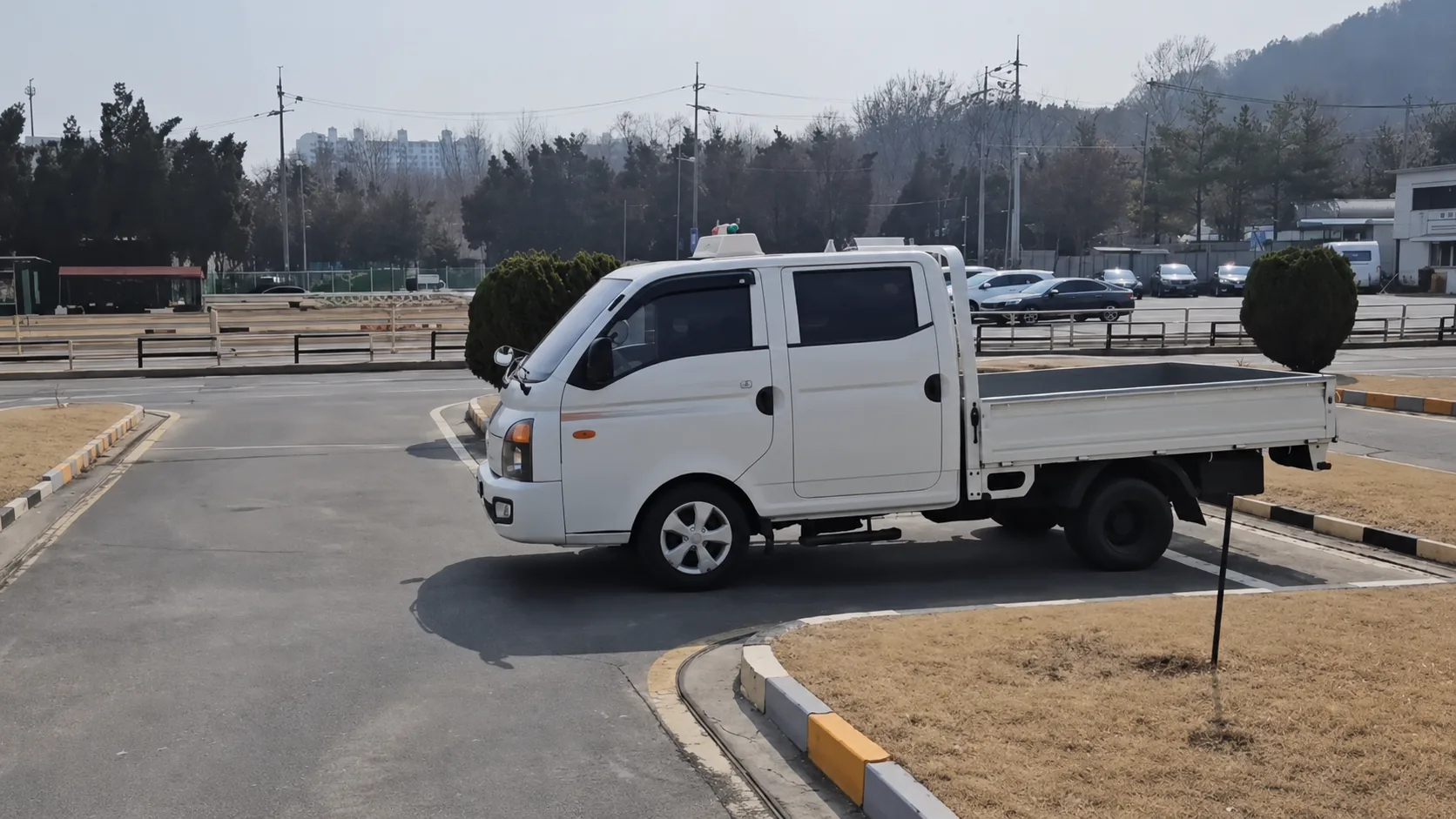
Four hours on the circuit, then the skills test on the same visit where scheduling allows. Skills tests run Tue and Fri at 11:00 and Sat at 14:00.
Six hours of on-road training, stacked across one or two days, then the road test. Road tests run Mon to Sat, 09:00 to 16:00.
Three trips to Anyang in total, if it is scheduled properly from the start. That is a very different proposition from the daily commute people imagine when they see the distance.
The main reason anyone makes this journey. Theory, circuit and road instruction, for over ten years.
Practical hours stacked into full days, so the course is three trips rather than ten.
If the journey is not worth it for what you need, we will say so before you buy a ticket.
Pyeongtaek, Jije, Seojeong-ri and Songtan are all on Line 1. Take a northbound train through Osan, Byeongjeom, Suwon and Geumjeong to Gwanak Station, then Exit 1 and a five-minute walk. There is no transfer, but allow well over an hour on the train and prefer express services where available.
About three to Anyang if it is scheduled as blocks from the start: the Saturday theory class, a full day for course practice plus the skills test, and one or two days for road practice plus the road test. The written test is taken at an examination centre near you.
It can. Status of Forces Agreement personnel do not always hold an ordinary Alien Registration Card, and the documents used to evidence residence and identity differ from the standard civilian route. USFK also has its own on-installation driving requirements, separate from the Korean licence. Tell us your status before you travel.
At whichever driver's licence examination centre is convenient to you. There is no reason to travel to Anyang for the written test, since it is a government service rather than an academy one.
Yes, and from Pyeongtaek you should. Tell us at registration and we will schedule your four hours of course practice and six hours of road training into full days rather than single sessions.
Send us your residence status and how much time you can take in blocks. If the journey is not worth it for what you need, we will say so before you buy a train ticket.
We'll reply in English with the total cost, the next start date and what to bring.
